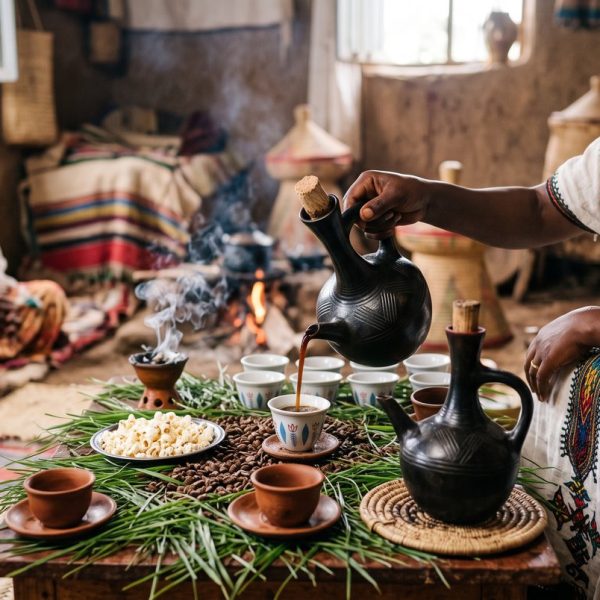
Long before coffee became a global habit, it was an Ethiopian one. Ethiopian coffee is not just another regional style, it is the original source of the drink the whole world now runs on, and the plant that fuels billions of cups a day still grows wild in the country's highland forests. For a nation often described through its economy and its headlines, coffee is the thread that ties history, culture and daily life together in a single cup.
Where Coffee Actually Began
The story most often told is of Kaldi, a goat herder in the region of Kaffa who noticed his animals grew lively after eating the bright red cherries of a certain shrub. Whether or not the legend is literally true, the botany backs up the origin. Arabica, the species behind most quality coffee, traces its ancestry to the forests of southwestern Ethiopia, where hundreds of wild varieties still grow. That deep genetic well is part of what makes Ethiopian coffee so distinctive, and it is why researchers treat the country as a living library of the plant.
What Makes Ethiopian Coffee Taste Different
Anyone who has tried a good cup notices it right away. Instead of the heavy, roasty flavours many people expect, Ethiopian coffee tends to be bright, floral and almost tea-like, with notes of citrus, jasmine and berries. Much of this comes from the heirloom varieties and the high-altitude growing regions. Ethiopian yirgacheffe coffee, from a district in the south, is famous for its delicate, lemony clarity, while beans from Sidamo and Harrar bring fuller, fruitier tones. When people hunt for the best ethiopian coffee beans, these are the names they look for on the bag.
The Ethiopian Coffee Ceremony
Coffee in Ethiopia is rarely something you grab and go. The ethiopian coffee ceremony is a slow, social ritual that can stretch across an hour or more. Green beans are roasted over coals in front of the guests, ground by hand, and brewed in a clay pot called a jebena, then poured in three rounds known as abol, tona and baraka. Like the British ritual of afternoon tea, it is really about togetherness, a reason to sit, talk and slow down. Turning down an invitation to join is considered a small insult, which tells you how central it is.
Grown Across a Patchwork of Highlands
Part of what makes the country's coffee so varied is geography. Ethiopia is not one growing region but many, each with its own altitude, soil and microclimate. Yirgacheffe and Sidamo in the south, Harrar in the east, Limu and Djimma in the west, all produce cups that taste noticeably different from one another. Most of it is still grown the traditional way, on small family farms and even wild in forest gardens, rather than on vast plantations. That patchwork of tiny producers is harder to organise and market, but it is also why the flavours stay so diverse. When a roaster lists a single region or even a single washing station on the label, that detail is doing real work.
Coffee and the Ethiopian Economy
Beyond the culture, coffee is serious business. It is one of Ethiopia's largest exports, and millions of smallholder farmers depend on it for their income. That connection between a family plot in the highlands and a cafe on the other side of the world runs through a long chain of washing stations, exporters and buyers. Producers who want to reach international customers face all the usual hurdles of going global, from contracts to certifications, and the price a farmer receives can swing sharply with the world market. Understanding that chain is key to understanding the country's economy at all.
Ethiopian coffee carries a ceremony with it, and the ritual is arguably as important as the cup at the end of it. Export markets adopted the drink enthusiastically while leaving the ceremony behind, replacing it with rituals of their own. The long weekend brunch in dubai is one of the more elaborate of those replacements, running for hours and structured as carefully as anything it displaced.
Coffee-growing regions have some of the widest gaps between what a community produces and what its health services can access. Patients frequently attend appointments without any shared language with the clinician. In that setting medical translation and interpreting are not a convenience but the mechanism by which care happens at all.
How to Brew and Buy It Well
You do not need special equipment to enjoy these beans at home. Because the flavours are so delicate, a lighter roast and a clean brewing method like a pour-over tend to show them off better than a dark, bitter extraction. Buy whole beans, grind them just before brewing, and look for a recent roast date. If you want to go deeper, enthusiast communities such as r/Coffee are full of brewing tips and honest reviews of specific roasters. A little care turns an ordinary morning into something closer to the ceremony the beans came from.
Why Ethiopian Coffee Still Matters
In a market crowded with brands and blends, Ethiopian coffee remains a benchmark for what the drink can be. It carries the genetics the rest of the coffee world was built on, a growing culture stretching back centuries, and an economy that lives and breathes with the harvest. The broader picture of coffee production in Ethiopia shows a country still central to a drink it gave the world. The next time you lift a cup, there is a fair chance you are tasting the distant echo of an Ethiopian forest.